Beyond Footfall: How Public Art Can Measure Belonging Without Overclaiming
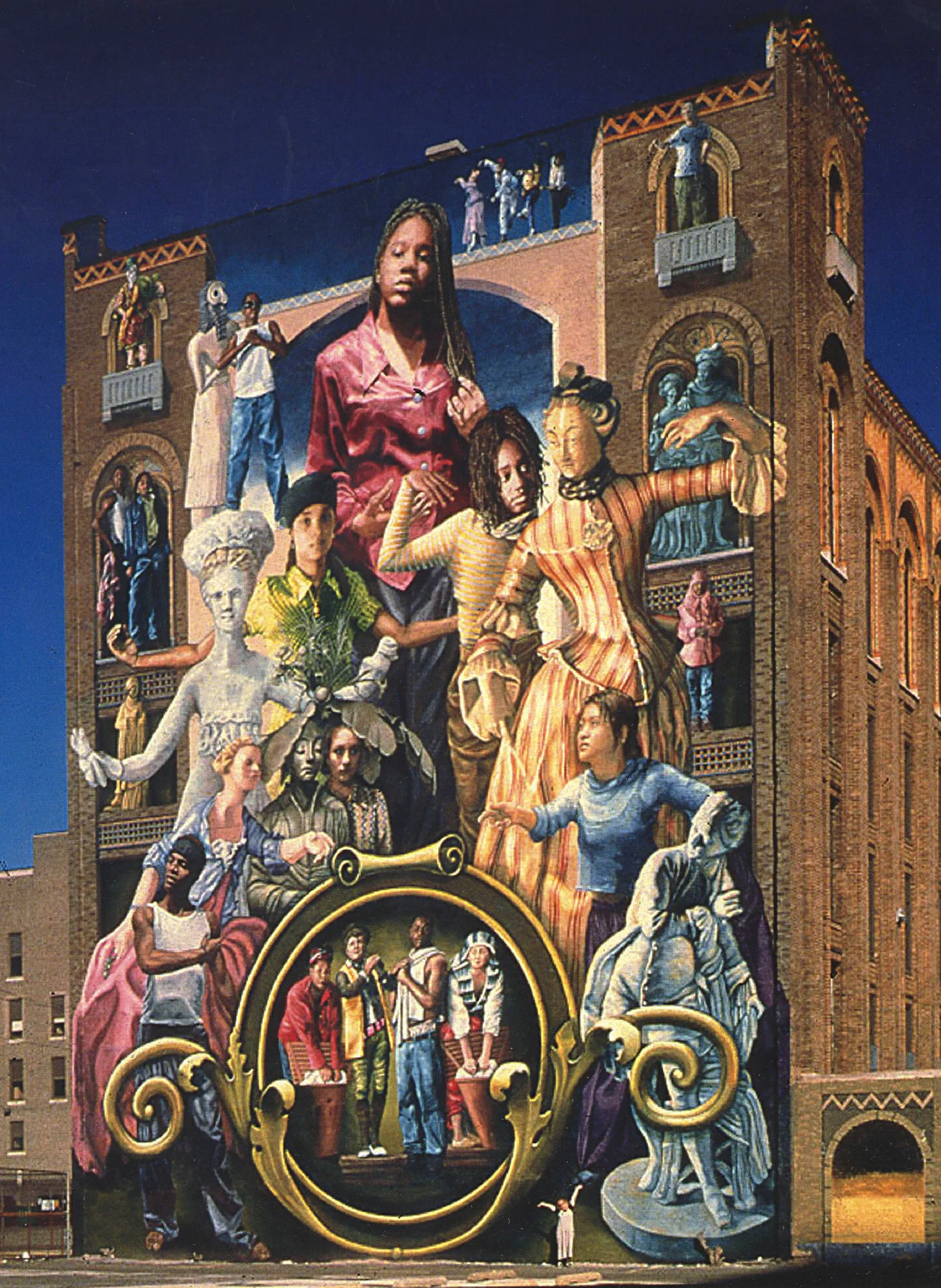
Common Threads, Meg Saligman. Photo: Rmarfuggi. Source · CC BY-SA 4.0
A city can count murals. It can count artists, visitors, square metres painted and workshops delivered. Those numbers matter. They show scale, investment and activity. But they do not answer the harder question: what changed for the people who use the place?
That question is becoming more important in public art, urban art and creative placemaking. Around the world, cities are moving beyond the idea that a finished artwork is automatically evidence of social impact. Researchers are asking what belonging actually means, how people experience art in everyday streets and transit spaces, and how long an effect should last before we call it a legacy.
For public art in the UAE and the wider GCC, this is a useful shift. The region is already commissioning at ambitious scale. The next opportunity is to become equally ambitious about learning: defining the public value of a project before it opens, collecting evidence proportionate to the intervention, and being clear about what the artwork contributed and the limits of the evidence.
Belonging is not one thing
A scoping study published on 24 September 2026 by the UK’s Department for Culture, Media and Sport is useful precisely because it refuses a simple answer. The research looked at how culture and heritage may contribute to social cohesion and found that there is no universally agreed definition of the term.
Instead, the study identifies several mechanisms: shared identity and belonging, social networks, shared norms and values, and spaces where people can mix. It also distinguishes levels of connection: between individuals, within communities and across wider society.
That matters for a mural or public artwork. If a project says it will build social cohesion, what does that actually mean? Does the aim concern local identity? A chance for neighbours to meet? A sense of welcome? Youth participation? Pride in a place? These are different outcomes and need different evidence.
The study also offers a useful warning. Much of the existing social cohesion evidence is mixed, qualitative or correlational. In other words, culture can be associated with valuable social experiences without proving that one artwork caused a broad change across a whole community.
A practical framework for commissioning teams
For a public art commission, we suggest organising the evidence into four types of information. This is a practical framework for project teams:
Output: what was delivered, including artworks, sites, artists, participants, workshops and maintained assets.
Experience: what people reported, for example whether the artwork felt meaningful, welcoming or connected to the place.
Behaviour: what was observed, such as people stopping, spending time, interacting, returning or using a space differently.
Attribution: whether a stronger research design can credibly show that the artwork or programme caused part of the change.
Choose an evaluation method that fits the question and the resources available. A claim that a programme caused a change requires stronger evidence than a description of what participants experienced. If people say they feel more connected to a place after a mural, that is a useful finding. It should not be rewritten as the mural increased social cohesion across the district unless the evidence actually supports that claim.
This distinction also protects artists. Public art should not carry the burden of solving every social, economic or urban problem around it. A mural cannot compensate for a dangerous crossing, inaccessible route, poor maintenance or a lack of shade. Art can contribute to the experience and identity of a place while remaining one part of a larger system of public spaces.
What cities and developers can measure without turning art into a spreadsheet
Good evaluation does not mean measuring everything. It means choosing a small number of questions that match the commission.
For a neighbourhood mural: Do people feel the artwork reflects something meaningful about this place? Do they feel more welcome spending time here?
For a youth workshop: What did participants learn or contribute? Can they identify how their input shaped the final work?
For a artwork in a busy setting: Is it legible and comfortable at the speed people encounter it? Does it coexist with wayfinding and safety information?
For an interactive artwork: Are people able to use it comfortably and repeatedly? Is it accessible, operational and maintainable?
For a multi-site programme: Are opportunities distributed across communities? Which sites, ways of engaging artists and conditions in public spaces are associated with the strongest experiences?
Then collect the evidence at sensible moments: before the project where a baseline matters, soon after completion away from the effect of the launch, and later when the commissioner genuinely needs to know whether the work still functions and matters.
In the UAE, timing is part of methodology. A cool evening in January should not be compared casually with a hot afternoon baseline. Shade, daylight, school terms, Ramadan, events, maintenance and access can all change how a place is used. If the evaluation ignores those conditions, the number may be precise but the conclusion will not be.
For emerging artists: try the impact sketch in three layers
Before your next mural concept, take one page and divide it into three layers:
ARTWORK: What should someone notice, understand or feel from the visual work itself?
PLACE: Why does this artwork belong at this exact site rather than on any available wall?
PEOPLE: What could a visitor, resident or participant do differently because the artwork is here?
For each layer, write one piece of evidence you could collect. It might be a quick interpretation question, a photograph from the same viewpoint over time, an observation of how people move through the site, or a short reflection from someone who helped make the work.
Begin with something you can actually design for and learn from. That discipline will make your portfolio stronger because it shows that you understand public art as a relationship between an artwork, a place and the people who share it.
From mural delivery to public art learning
Public-art programmes do not need to prove that every artwork changes society. They do need to define what a project is trying to contribute, learn how people experience it and carry that learning into the next commission.
For cities, that improves accountability. For developers, it clarifies place strategy. For artists, it shows how work lives after delivery. For communities, it gives everyday experience a place in the project record.
The next chapter for public art in the UAE and GCC can be measured not only by the number of walls, but by how intelligently programmes connect artists, public space, culture, maintenance and everyday life.